
Street harassment steals a little freedom every day from women and girls across Africa. A whistle, an obscene remark, a hand that forces itself on you: the scene changes, the fear stays. This op-ed denounces street harassment, but it also offers concrete steps and remedies.
Street Harassment: A Street That Doesn’t Belong to Every Woman
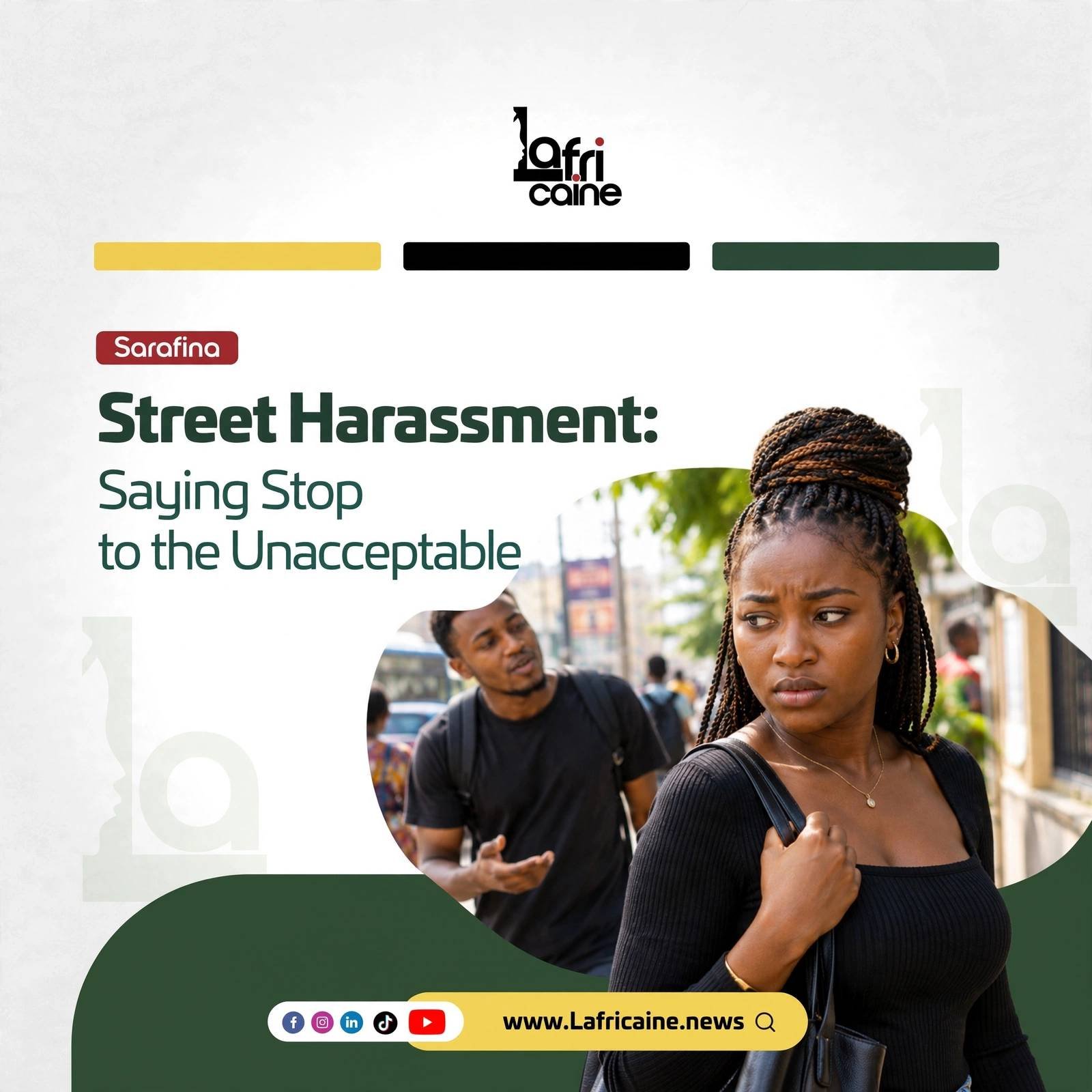
First, people call it « flirting, » a « compliment » or a « joke. » Yet street harassment is no game: it is violence. Insistent stares, sexual comments, threats, obscene gestures, stalking and physical assault: all of it is street harassment.
These acts violate a fundamental right, the right to move around freely. As a result, women change sidewalks, outfits or schedules. Some even give up the route to school or work.
A Look, a Word, a Fear: What Harassment Costs
Indeed, street harassment leaves marks. Fear, anger, humiliation and a constant sense of insecurity weigh on mental health. Consequently, victims of street harassment adapt, stay silent and hold themselves back, even though they did nothing wrong.
Worse still, society often blames them for having « provoked » it. This logic of guilt stems from paternalism. It decides for women what they should wear or keep quiet about. In reality, in every case of street harassment, responsibility lies with the aggressor.
Above all, a hostile street can lead to the worst. Thus, unpunished street harassment normalizes violence, all the way to femicide.
Street Harassment: What the Law Says in Africa
Many women do not know it: laws against street harassment exist. However, their enforcement remains uneven. Here are verified benchmarks, to be confirmed with a legal professional in your country.
- African Union. The Maputo Protocol dates from 2003 and has applied since 2005. Thus, it requires states to prevent and punish violence against women.
- Morocco. According to Le360, harassment in a public place carries six months in prison. It also brings a fine of 2,000 to 10,000 dirhams.
- Tunisia. The law adopted in July 2017 penalizes sexual harassment in public spaces, according to Human Rights Watch. It also provides for specialized police units.
- Egypt. Penalties have been toughened. Thus, according to Egypt Independent, harassing someone with words or gestures can mean two to four years of detention.
- French-speaking West Africa. According to the RFLD, Côte d’Ivoire punishes harassment with one to three years in prison. Burkina Faso does too. Benin has a dedicated law.
However, these laws often target sexual harassment in the broad sense. Therefore, always ask which offense applies to your situation.
Street Harassment: What to Do in the Moment and After
In the face of street harassment, react, or don’t. Saying no, setting a limit or ignoring it: every choice is legitimate. But your safety comes first, even when facing street harassment.
Gather evidence. First, note the place, the time and a description of the aggressor. Then, if it is safe, record a voice message or a video.
File a complaint. Next, go to the police station or gendarmerie with your evidence. However, if the reception is difficult, turn to a victim support association or an activist. They can accompany you.
Talk about it. Thus, confide in someone you trust. Because silence protects the aggressor, never the victim.
Learn to defend yourself. Admittedly, a self-defense class gives you reflexes and confidence. Nevertheless, running away is still a defense.
Stand in solidarity. So, approach the harassed woman, speak to her like a friend, offer to walk with her. A simple gesture sometimes stops everything.
To Men and Boys: Your Silence Is a Choice
Women are not objects. Street harassment is not something they owe you. Before whistling or commenting, ask yourself a question. What if it were your mother, your sister or your daughter?
Your gaze is not an invitation. Your remarks are not compliments. Moreover, humiliating a woman makes you neither a strong man nor a gang leader.
Better still, become allies against street harassment. So, step in calmly when you witness it. If a friend harasses someone, tell him to stop. But if he keeps going, walk away from him.
Street Harassment: Families, Schools and States Must Act
Indeed, victims cannot carry this fight alone. First, families must teach boys respect from childhood. Then, schools must talk about consent and boundaries.
Meanwhile, states must enforce existing laws. They must also train police officers to receive victims properly. Finally, media and communities can stop mocking those who speak out.
Giving the Street Back to Every Woman: A Whole Continent’s Fight
Because a safe street is no luxury. It is a right, and it applies to every girl, every mother, every grandmother. This freedom has a history. Women fought before us, as International African Women’s Day reminds us.
So, let us break the silence together on street harassment. Share this op-ed against street harassment, talk about it around you and support those who dare to speak out. Every voice counts.
Pélagie BLEWUSSI