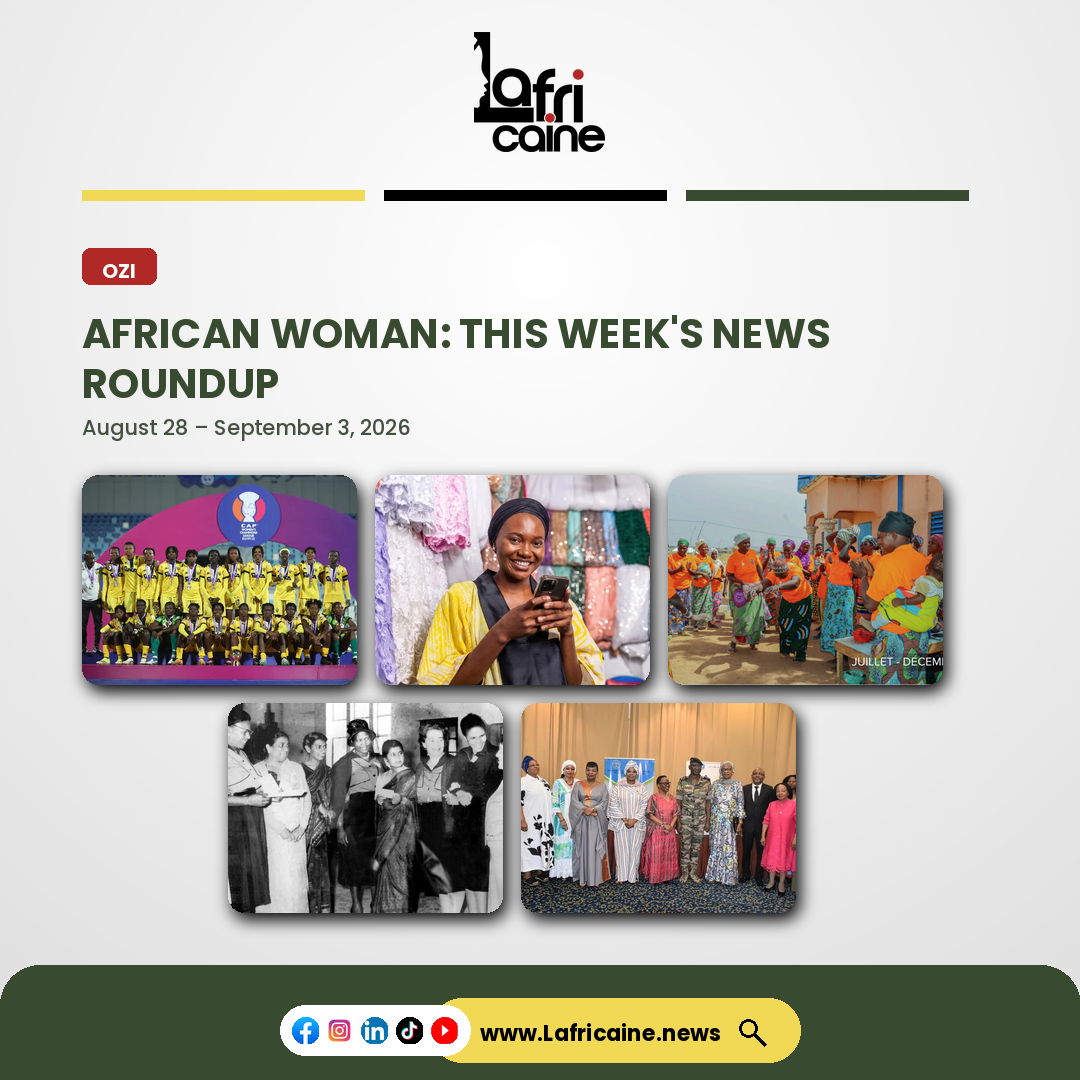
The African woman is at the heart of this week’s news. From entrepreneurship and leadership to artificial intelligence, culture, sport and women’s rights, African women continue to play an increasingly important role in shaping the continent’s future. Here is our weekly roundup of the key stories concerning African women from August 28 to September 3, 2026.
Once again this week, the stories surrounding the African woman tell a story of ambition, resilience and achievement. They also reveal a growing determination among women not simply to benefit from change, but to take part in the decisions shaping Africa’s future.
African Woman: A New Economic Force
Economic empowerment remains one of the major challenges facing the African woman.
On September 2, the African Development Bank and AXIAN announced a digital finance programme aimed at supporting 34,000 women-led businesses across several African countries. The programme relies in particular on the Mixx and MVola digital financial platforms and also includes training in financial literacy, digital skills and entrepreneurship.
The initiative will primarily target Madagascar, Tanzania and Senegal for business-focused financial services, while the training component will also extend to Togo and Comoros.
This announcement comes at a time when African women entrepreneurs continue to face significant barriers to accessing capital, financial services and opportunities for business growth.
The question, therefore, is no longer whether women are starting businesses. They already are.
The real question is: how can women-led businesses be given the resources they need to grow?
Access to credit, business support, digital tools, professional networks and markets are all essential factors that can help turn a small business into a sustainable enterprise.
For the African woman entrepreneur, access to finance therefore remains a critical issue.
Starting a Business Is Not Enough: Women Need to Be Able to Grow
A woman-led business can create jobs, support a family and contribute to the development of an entire community.
But without adequate financing, many businesses remain small.
The development of digital financial solutions could therefore help remove some of the barriers facing African women entrepreneurs.
The goal is clear: moving beyond a culture of assistance towards value creation and economic power.
To learn more about this initiative, visit the African Development Bank.
African Woman and Leadership: A New Generation Is Rising
Leadership is another major theme in this week’s news about the African woman.
Young African women are increasingly entering spaces of civic, political and community participation.
Across the continent, women’s leadership is also gaining greater visibility in business, governance, innovation and civil society.
This new generation of women leaders wants to take part in conversations about governance, democracy and the future of their societies.
But it also raises an essential question: how much influence do young women actually have in decision-making spaces?
Being represented in an institution does not automatically mean having power.
The real challenge for African women’s leadership is therefore to turn representation into genuine influence.
African Woman and Artificial Intelligence: Africa Cannot Afford to Be Left Behind
Artificial intelligence is rapidly transforming the worlds of work, education, business and information.
Should the African woman simply watch this transformation unfold?
The answer is increasingly clear: no.
Data, innovation and technology are becoming increasingly important within Africa’s development strategies.
The representation of women in technology is therefore becoming a strategic issue.
Recent discussions involving African women in technology and AI have also highlighted the importance of local data and technologies adapted to African realities.
When women take part in designing technologies, they can help create solutions that are better suited to Africa’s social and economic realities.
Their absence, on the other hand, could reinforce inequalities that already exist.
Technology as a New Path to Empowerment
For the African woman, technology can represent much more than a career opportunity.
It can make it easier to access education, finance, information and markets.
It can also enable young women entrepreneurs to work beyond geographical boundaries.
Africa’s digital future must therefore also be a future in which women have a voice and a meaningful role to play.
To explore more resources on development and gender equality in Africa, visit the United Nations Development Programme — Africa.
African Woman: When Culture Becomes an Economic Force
Creativity is also an important source of empowerment for the African woman.
Fashion, crafts, design, photography, music and heritage preservation are creating new opportunities for young African women.
Africa’s heritage is no longer simply something to preserve as a memory. It can also become a source of income, innovation and entrepreneurship.
A woman creator can build on a skill passed down through generations, develop a brand, sell online and reach an international audience.
Heritage can therefore become an economic resource.
And creativity can become a pathway to independence.
This deserves particular attention on a continent where cultural and creative industries have significant potential to generate employment for young people and create opportunities for women entrepreneurs.
African Woman: 70 Years of Struggle in South Africa
The story of the African woman cannot be separated from her history.
In South Africa, 2026 marks the 70th anniversary of the 1956 Women’s March, a historic mobilisation in which more than 20,000 women marched to the Union Buildings in Pretoria to protest the extension of pass laws to women.
The mobilisation was notably led by Lilian Ngoyi, Helen Joseph, Rahima Moosa and Sophia Williams-De Bruyn.
The march remains one of the most powerful symbols of African women’s political engagement.
Above all, it reminds us that women have always played a role in the major political transformations of the continent.
Today, the battles may have changed.
Women are calling for greater economic power, political representation, security, justice and access to opportunities.
From 1962 to 2026: An African Story That Continues
The history of women’s mobilisation also has a broader pan-African dimension.
In 1962, African women from different countries gathered in Dar es Salaam to lay the foundations for a pan-African organisation dedicated to women.
This movement would lead to the creation of the Pan-African Women’s Organisation and, later, the International Day of the African Woman.
Read on Lafricaine.news: International African Women’s Day: July 31, 1962, the Day African Women Wrote Their Own History
This history reminds us that African women’s mobilisation is not a recent phenomenon.
It is deeply rooted in the political and social history of the continent.
African Woman and Rights: Concerns Remain
But the news surrounding the African woman is not limited to achievements.
Across the continent, women’s rights organisations and activists continue to raise concerns about violence, discrimination, unequal access to resources and the protection of hard-won rights.
These issues remind us of an essential reality: rights that have been won cannot simply be taken for granted.
Civil society therefore continues to play an important role in defending them.
This is particularly true when it comes to fighting violence, discrimination and practices that restrict women’s autonomy.
For more information on international issues relating to gender equality, explore UN Women Africa.
African Woman: Understanding the Words Behind the Struggle
Defending women’s rights also requires the ability to name and understand the realities women experience.
Paternalism, female genital mutilation, femicide, tokophobia… These terms help put words to issues that are sometimes overlooked or rendered invisible.
To better understand these concepts and their place in discussions about African women’s rights, explore The Lafricaine.news Women’s Glossary:
The Lafricaine.news Women’s Glossary
Because naming a reality is also a way of making it visible.
And making a reality visible allows us to better understand it, talk about it and, sometimes, fight it more effectively.
African Woman: Achievements Deserve to Be Told Too
The news about the African woman must also make room for victories.
Sport is a perfect example.
The performances of African female athletes regularly demonstrate that women from the continent can reach the highest levels of competition despite the obstacles they face.
Among these inspiring figures, Noélie Yarigo stands out for her determination.
Her athletics career is a reminder that African women’s achievements are also being built on tracks, in stadiums and at international competitions.
Also discover: Noélie Yarigo, Masters World Champion in the 800m
These stories matter.
They allow young African girls to see women who look like them occupying spaces that were once considered out of reach.
African Woman: Major Challenges Remain
Behind the achievements, several challenges continue to affect the African woman.
Access to finance remains inadequate.
Women remain underrepresented in many decision-making spaces.
Domestic work and unpaid care responsibilities continue to fall disproportionately on women.
Violence and discrimination also continue to affect many African women.
These realities show that women’s empowerment cannot be reduced to a few isolated programmes.
It requires long-term policies, investment, better education, equal access to resources and genuine political commitment.
African Woman: From Visibility to Real Power
All these stories ultimately tell the same story.
The African woman is becoming increasingly visible.
But visibility is not enough.
A woman can be visible in the media without having economic power.
She can hold a position within an institution without having a meaningful role in decision-making.
She can create a business without having the financial resources needed to grow it.
She can have rights protected by law without always being able to exercise them in practice.
The next major challenge, therefore, will be to transform visibility into influence, independence and decision-making power.
What to Remember From This Week’s African Woman News
💰 Women’s Entrepreneurship
A new digital finance programme aims to support 34,000 women-led businesses in Africa and provide thousands of women with training in finance, digital skills and entrepreneurship.
👩🏿💼 Women’s Leadership
Young African women are increasingly entering spaces of civic, political and economic participation.
🤖 Technology
African women must be able to play a full role in shaping the continent’s digital future and its approach to artificial intelligence.
🎨 Culture
Heritage and creativity are becoming important tools for entrepreneurship and economic independence for African women.
⚖️ Women’s Rights
Current debates surrounding women’s rights are a reminder that hard-won gains must continue to be protected.
🏃🏿♀️ Achievements
Athletes such as Noélie Yarigo are helping give greater visibility to African women while inspiring future generations.
African Woman: What This Week’s News Tells Us
This week, the news about the African woman reflects a continent in motion.
Women are building businesses, innovating, creating, leading and speaking out.
They are entering fields that have traditionally been dominated by men, including finance, technology, politics and the creative industries.
But they also continue to face structural barriers: limited access to finance, inequality, violence, underrepresentation in decision-making and the fragility of some hard-won rights.
The real challenge, therefore, is no longer simply to give African women greater visibility.
It is to enable them to turn that visibility into real power and meaningful action.
Conclusion: The African Woman Is No Longer Simply Asking for a Seat at the Table
The key message from this week’s news can perhaps be summed up in one sentence: the African woman is no longer simply asking for a place in Africa’s future; she wants to help build it.
In business, politics, technology, sport and culture, a new generation is moving forward.
She creates.
She builds businesses.
She innovates.
She speaks out.
She carries history forward.
And she refuses to let her story be written without her.
This is the Africa that Lafricaine.news wants to tell the story of: an Africa shaped by women who are changing the continent, women fighting for their rights, but also women building, achieving and opening doors for those who will come after them.
Join us next week for another edition of “African Woman: This Week’s News Roundup.
Pélagie BLEWUSSI