
Some garments we admire for their cut. Others, we look at long before we ever think to wear them. Adire belongs to that second category. With its deep blues and white patterns, this fabric grabs your attention instantly. But its beauty isn’t just about color. It also lives in the gesture, the time, and the memory it carries.
For the very first article in Oshun, our new fashion and beauty section, it was hard to imagine a more fitting place to start.
What Exactly Is Adire?
The word « adire » comes from two Yoruba terms: adi, to tie, and re, to dye. Literally, « tied and dyed. »
As documented by London’s Victoria and Albert Museum, the term took hold in the early 20th century to describe cotton cloth dyed with natural indigo, decorated through resist techniques that stop the dye from reaching certain parts of the fabric.
Adire Was Born in the Hands of Abeokuta’s Women
You simply can’t tell this story without mentioning Abeokuta, the southwestern Nigerian city that became the true engine of this industry starting in the 1920s.
Egba women turned a household skill into a full-scale regional industry. Thanks to access to imported cotton cloth, they scaled up production until Itoku market became one of the largest textile trading hubs in West Africa.
Historian Judith Byfield, a professor at Cornell University and author of the definitive book The Bluest Hands: A Social and Economic History of Women Dyers in Abeokuta, puts it plainly: in the 1920s, the adire industry was simply the most lucrative industry in Abeokuta. These women controlled the entire chain, designing the patterns, dyeing the cloth, and selling it.
Some artisans even signed their work. The V&A has documented pieces where a small symbol, discreetly tucked into the hem, served as the maker’s signature, proof that these women were anything but anonymous.
When Indigo Became a Tool of Resistance
At a key moment in history, adire’s economic story merges with the political story of Nigerian women.
In 1944, teacher and activist Funmilayo Ransome-Kuti founded a women’s club in Abeokuta that, by 1946, had grown into the Abeokuta Women’s Union. The organization quickly mobilized tens of thousands of women against a tax imposed on women, including very young girls by colonial authorities, as well as against abusive price controls placed on market traders.
The movement, remembered today as the Abeokuta Women’s Revolt (1946–1949), ultimately led to the local ruler’s temporary abdication. What stands out in particular is the role adire played in the uprising: according to Garland Magazine, Ransome-Kuti had the fabric worn as a uniform by the thousands of protesting women, visually erasing the line between illiterate market women and educated elites, presenting a united front against colonial power.
The garment stopped being just a garment. It became a political statement, worn on the body.
Three Techniques, a Craft Passed Down From Mother to Daughter
Behind every piece of adire lies one of these ancestral techniques, still passed down from generation to generation today:
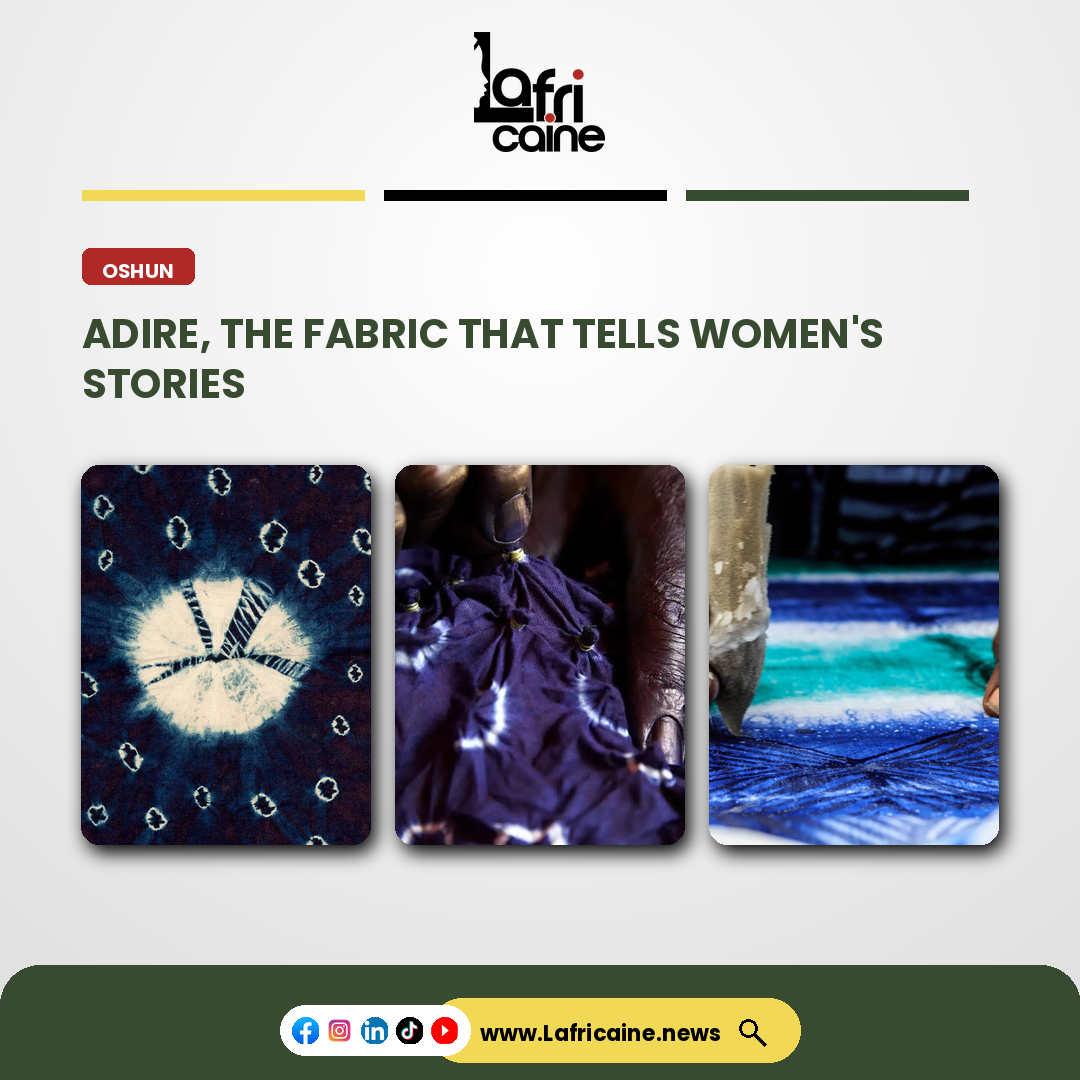
- Adire oniko: the cloth is tied with raffia, seeds, or small stones, creating white circles against a blue background.
- Adire alabere: patterns are stitched with thread before dyeing, producing fine, precise lines.
- Adire eleko: a cassava starch paste is hand-painted directly onto the fabric, acting as a resist before the indigo bath.
The Hidden Language of Adire Patterns
Yet no adire pattern is ever purely decorative.
The V&A cites the Ibadandun pattern, meaning « Ibadan is good » in Yoruba, whose design evokes the five pillars of Mapo Hall, a landmark building in the city.
The Smithsonian National Museum of African Art, meanwhile, holds a piece called sun bebe, « lifting up the sun »: a pattern referencing the waist beads worn by young girls during ceremonial dances that precede certain weddings.
Looking at an adire cloth, then, calls for a little more attention. You’re no longer just seeing lines, you’re searching for their meaning, and sometimes glimpsing the story behind them.
Adire, From Indigo Blue to a Full Color Palette
Traditionally, adire existed only in the shades of blue offered by natural indigo, deepening with each successive dye bath.
It wasn’t until the 1960s that the palette expanded. The arrival of colorfast synthetic dyes, introduced notably by figures like Betty Okuboyejo in Abeokuta, made it possible to render adire patterns in entirely new colors: red, yellow, green, orange.
These multicolored pieces, often called « kampala, » remain a point of debate among purists, some of whom reserve the name « adire » strictly for indigo pieces. In practice, though, this range of colors has become the norm across much of today’s production, much to the delight of women who can now pick a shade to match their mood or outfit.
A Decline, Then a Revival
Like many artisanal crafts, adire went through some difficult decades. The arrival of lower-quality synthetic dyes in the late 1930s gradually drove down demand for the finest pieces.
The fabric could have disappeared. Instead, the 1960s brought renewed interest, with new patterns and new uses emerging beyond the traditional wrapper cloth.
Since then, figures like artist Nike Davies-Okundaye have actively kept the tradition alive, notably through her arts center in Oshogbo, where she continues to train new generations in the ancestral techniques of adire.
Adire Today, From Workshops to International Runways
That transmission has paid off. Designer Amaka Osakwe, founder of the label Maki Oh, made adire the signature of her brand, pairing it with contemporary silhouettes. According to the official LVMH Prize page, her designs have been worn by Michelle Obama, Solange Knowles, Beyoncé, and Rihanna.
Other Nigerian labels, including Lagos Space Programme and Orange Culture, have since helped cement the fabric’s place in international contemporary fashion.
Today, adire is no longer confined to the traditional wrapper. The Cable Lifestyle highlights its successful crossover into streetwear: jackets, sets, even caps, worn by a generation that has turned its heritage into a genuine style statement, without ever needing to turn it into a costume.
Adire, a Thread That Ties It All Together
Adire, then, is far more than a pretty blue-and-white pattern. It’s the story of women who turned a household skill into an industry, a fabric into a tool of political resistance, and a technique into a true language.
That’s exactly the spirit we want to bring to Oshun: celebrating African fashion and beauty without ever losing sight of the often female stories behind them. A mission that ties directly back to the one we set for ourselves in our very launch editorial.
You don’t just wear adire. You wear a story.
Pélagie BLEWUSSI